Knowledge Portal
HARTMANN SCIENCE CENTER

Visit our designated HARTMANN SCIENCE CENTER to get scientific information relevant around our products.
Learn more


World Sepsis Day takes place annually on September 13 and is coordinated internationally by the Global Sepsis Alliance. In 2026, the day will once again focus on raising awareness about this life-threatening condition and its consequences, while highlighting the importance of preventing infections. Under the motto “Stop sepsis, save lives,” this awareness day marks the 15th year of fighting against sepsis—and we are taking part once again!

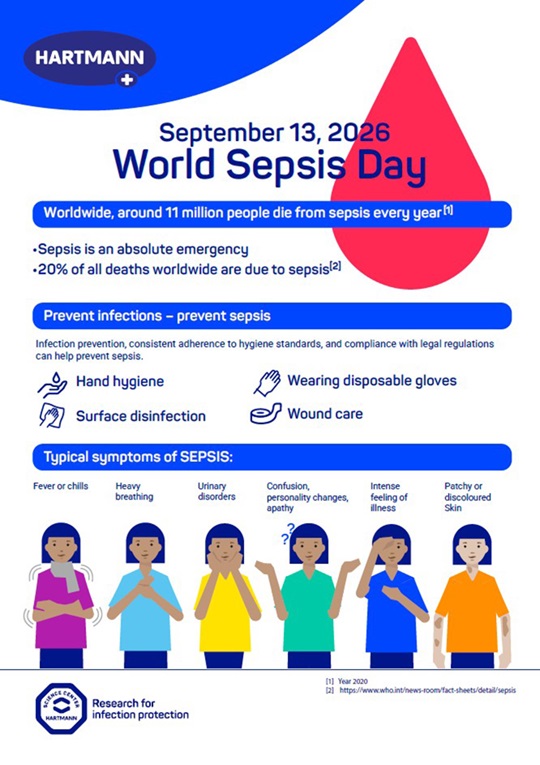
In 2020, there were approximately 50 million cases of sepsis and 11 million sepsis-related deaths worldwide—representing 20% of all global deaths [1]. Survivors also face significant challenges, as many suffer from long-term effects resulting from sepsis [2]. These include cognitive impairments, joint and muscle pain, but in extreme cases, the loss of limbs due to severe circulatory disorders requiring amputation [2, 3].
Recognizing sepsis is often difficult because there is no single specific symptom that clearly indicates the condition. Possible symptoms include confusion, severe pain, low urine output, severe breathlessness, a profound sense of illness, and mottled or discolored skin [1, 2]. Furthermore, a distinction can be made between “primary” and “secondary” sepsis. While in “primary” sepsis, no infection source can initially be identified (e.g., due to pathogen entry associated with vascular catheters), “secondary” sepsis is characterized by the spread of a known, local infection (e.g., a surgical site infection) [4].
However, sepsis does not only affect patients who have previously received hospital treatment. The risk of sepsis can also arise from a neglected urinary tract infection or be triggered by a lower respiratory tract infection (e.g., due to pneumococci). The individual risk of sepsis can therefore be reduced by keeping up to date with recommended vaccinations [5]. Targeted incontinence management also helps prevent urinary tract infections associated with incontinence. We also offer training on this subject at the HARTMANN Academy.
Implementing structured infection prevention programs in healthcare is a key component in preventing severe cases of healthcare-associated infections—particularly catheter-associated infections, ventilator-associated pneumonia, and surgical site infections—and, consequently, sepsis. This entails strict adherence to hygiene standards and compliance with legal regulations. International guidelines [6] emphasize that hospitals should implement antibiotic stewardship programs to ensure the rational use of antibiotics and reduce resistance. Additionally, they recommend a sepsis quality assurance program that includes screening for acutely ill high-risk patients as well as clear standard operating procedures for treatment.


Another important aspect is the conscious use of disposable medical gloves, which are also part of our product range. However, gloves are often used in situations where they are not required. In 2009, the World Health Organization (WHO) published a leaflet on this subject, listing clear indications for glove use—such as contact with blood or mucous membranes as well as during the insertion of vascular access devices/peripheral venous catheters (PVCs) or the administration of intravenous injections—while also highlighting situations where use is not indicated, such as vaccinations or blood glucose measurements [7]. Rational use can therefore also contribute to sustainability.
Wound care also requires special attention. The transition from a non-infected wound to an infected wound is driven by an increasing microbial burden. Classic signs and symptoms of local wound infection include redness, local warmth, swelling, pain, and delayed wound healing. Systemic infection can arise when microorganisms from a wound spread throughout the body via the vascular or lymphatic systems, potentially leading to sepsis. To reduce the risk of infection and promote wound healing, standard hygiene measures—such as hand disinfection and aseptic techniques—are essential as well when performing wound dressing procedures including therapeutic cleansing and wound bed preparation [8].
Consequent hygiene is also of great importance in the field of hemodialysis, particularly in patients with central venous dialysis catheters (CVCs), as these provide direct access to the bloodstream and increase the risk of catheter-associated infections. However, a 2024 study demonstrated that multimodal strategies—such as surveillance, training, and patient education—can significantly reduce dialysis-associated infections [9]. Our dialysis care kits support hygienic practices in outpatient dialysis centers.
World Sepsis Day on September 13 once again highlights the importance of early detection and prevention. Sepsis can affect us all—whether in healthcare settings or in everyday life. Join the movement and show your commitment to infection prevention and the fight against sepsis using the hashtags #WorldSepsisDay, #SaveLives, and #MissionInfectionPrevention. On the World Sepsis Day website, you can also find a wide range of campaign materials in various languages to use for your own initiatives. After all, only by working together can we save lives!